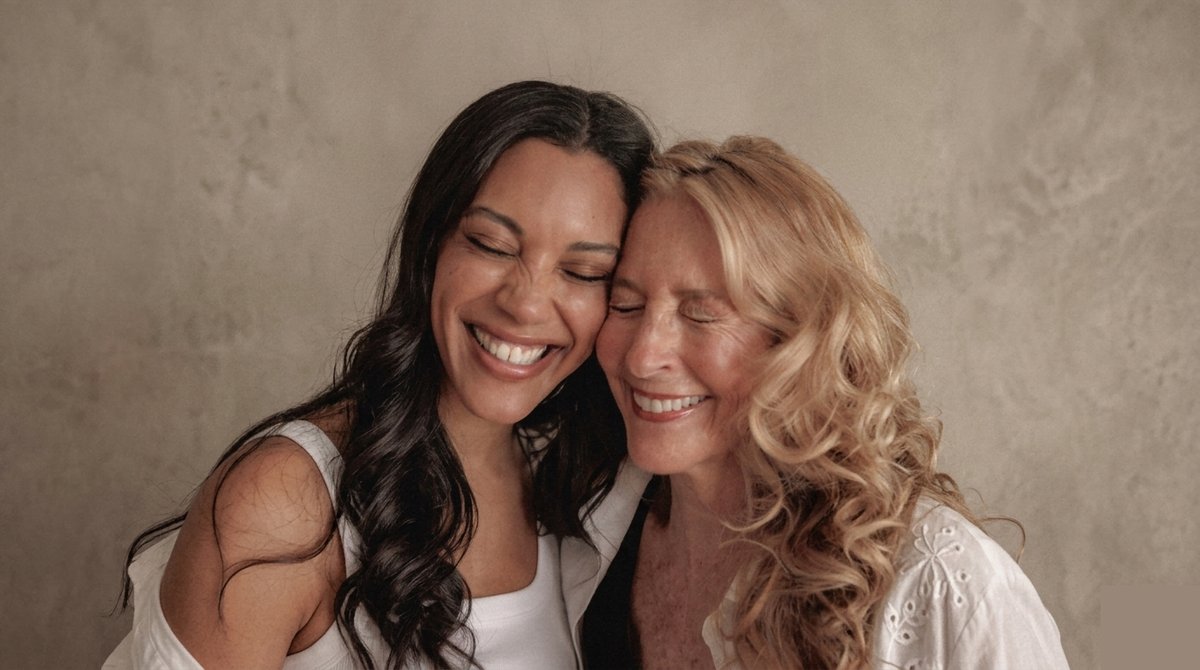
Most of us didn’t exactly inherit a menopause playbook. In fact, according to our Mother’s Day survey last year, nearly 90%* of women say their mothers didn’t speak openly about menopause or gave them no advice at all about what to expect. Seventy-eight percent don’t even know when their mom’s symptoms started.
That silence created a knowledge gap and a lot of confusion.
When asked, “What’s one thing your mom told you about menopause?” the answers were… sparse:
- “Nothing at all. Left on my own to figure it out.”
- “Hot flashes and mood swings.”
- “This too shall pass.”
- “Stick it out. She believed it was something we should suffer through.”
But here’s the shift: more than 70% of women* today say they’re talking openly with the next generation — daughters, nieces, younger friends — hoping to break the cycle.
So what menopause advice are we actually giving now?

It might start sooner than you think
If there’s one thing we’re correcting immediately, it’s the timeline.
When asked, “what’s one thing you wish your mom had told you about menopause?”, a lot of our responders said something along the lines of: That perimenopause can start in your 30s.
Perimenopause — the hormonal transition leading up to menopause — can begin years (even a decade) before your period stops. And yet, so many of us were blindsided:
-
“Perimenopause started at 38. I was diagnosed at 43.”
-
“I had no idea my night sweats at 40 meant anything.”
-
“I wish I knew the word perimenopause earlier.”
Translation: if something feels off, it might not be random. It might be hormonal.

It’s not just hot flashes
For years, menopause was reduced to a punchline: sweating and mood swings. When in reality, it’s a full-body experience.
“That it’s more than hot flashes — like sudden rage, UTIs, and brain fog,” said one responder.
We’re talking:
-
Skin changes
-
Sleep disruption
-
Anxiety or sudden irritability
-
Vaginal dryness and libido shifts
-
Hair thinning
-
Brain fog that makes you forget why you walked into a room
And yes, sometimes rage. The point isn’t to scare you; it’s to normalize it. Because once you can name something, you can deal with it.
You don’t have to just “deal with it”
A lot of our mothers were handed one message: endure. “Stick it out. She believed it was something we should suffer through.”
We’re rewriting that narrative completely. There are now more options than ever: hormone therapy, non-hormonal treatments, skincare designed for hormonal changes, supplements, pelvic floor therapy, and more. Suffering is not a requirement.

Advocate for yourself — because you might have to
Here’s the uncomfortable truth: not every doctor is well-versed in menopause. “...Doctors might dismiss you. Keep asking. You know your body,” one responder said.
Many women report being told they’re “too young,” “just stressed,” or “fine” when something clearly isn’t right. But if something feels off, push. Get a second opinion. Track your symptoms. Use the language — perimenopause, hormonal changes — even if no one handed it to you.
It’s not the end, it’s a change
Culturally, menopause has been framed as a kind of closing chapter. Fertility ends, youth fades, etc. etc. But that narrative is outdated, and honestly, lazy.
As one responder said: “It doesn’t mean the end — it’s just a different version of you.”
Yes, your body changes. Your priorities might shift. Your tolerance for nonsense may drop significantly. But many women also describe this phase as clarifying, liberating, even powerful.

Talk about it. Early and often
The biggest takeaway from all of this? Silence doesn’t serve anyone.
Because when we don’t talk about menopause, this happens: “My mom didn’t remember when hers started—and no doctor could tell me what mine meant.”
And we’re left piecing together symptoms in isolation. But the good news is that’s changing. More women are having these conversations in real time, sharing what’s happening in group chats, at dinner tables, in doctor’s offices, and yes, with the next generation.
*Source: Stripes Beauty. (2025). What’s Your Number: Mother’s Day Survey. Responses collected April 24–May 2, 2025, from 159 women on stripesbeauty.com. Additional data from Question 1 collected via Instagram (n = 833), indicating a majority did not openly talk about menopause with their mother.